• Products
  • Solutions
  • Support
  • Contact
  • Order OnlineOrder Online

What Are Granite Support Blocks Used For?

granite support blocks are compact, load-bearing pieces used to stabilize and elevate heavy structures. They commonly support countertops, masonry walls, outdoor kitchens, steps, monuments, and landscape features. Their dense stone composition handles substantial weight while resisting moisture, abrasion, and temperature changes. In practical installations, these blocks can distribute pressure across a broader surface. They may also reduce direct contact between a structure and wet soil or concrete.

A well-made block should have consistent dimensions, sound edges, and no deep cracks. Small defects can become serious under concentrated loads. Installers often place granite support blocks beneath posts, slabs, or precast components, then check alignment with a level. Thin shims may correct minor differences, but they should not replace proper sizing or stable foundations. Drainage matters too. Standing water can affect surrounding materials, even when granite itself remains durable.

Granite support blocks are not a universal solution. Their weight makes handling difficult, and rough surfaces may damage softer materials. I have seen projects focus on appearance while overlooking load paths and access for future repairs. That mistake is easy to make. A qualified contractor or structural professional should review unusual loads, elevated structures, and local building requirements. The correct block depends on weight, dimensions, soil conditions, exposure, and the supported material. Used thoughtfully, granite support blocks provide a durable, clean-looking foundation. Their performance still depends on careful design and installation.

What Are Granite Support Blocks Used For?

Definition and Basic Function of Granite Support Blocks

Granite support blocks are compact load-bearing pieces placed beneath granite slabs, edges, seams, and overhangs.

Their basic function is to transfer weight into the cabinet, wall, or structural frame. They also limit bending, vibration, and stress around vulnerable areas such as sink cutouts.

A 2.4-meter by 0.6-meter granite slab, 30 millimeters thick, can weigh about 115 kilograms. The exact weight changes with density and moisture.

Placement matters. Blocks should provide continuous, stable contact rather than touch the stone at one small point.

The Natural Stone Institute’s Dimension Stone Design Manual advises evaluating span, overhang, slab thickness, substrate, and joint location before selecting support.

A simple rule can mislead. A thick block may still fail when the cabinet is uneven or the adhesive bond is weak.

The 2024 U.S. Geological Survey Mineral Commodity Summaries placed U.S. dimension-stone production in the million-ton range for 2023, showing the scale of material used in construction.

That volume does not remove the need for site-specific checks.

Granite support blocks help prevent cracking, but they cannot correct poor installation.

On site, the weak point is often the contact surface, not the granite itself. Clean alignment, firm bearing, and measured overhangs remain essential. Small errors matter.

Common Applications in Construction and Landscaping

Granite support blocks provide stable, durable bearing points for heavy materials. In construction, crews place them beneath precast steps, equipment bases, beams, and small structural platforms. Their dense mineral structure resists crushing and moisture better than many softer materials. However, granite is not automatically suitable for every load. Engineers must check compressive strength, block thickness, surface flatness, and soil capacity.

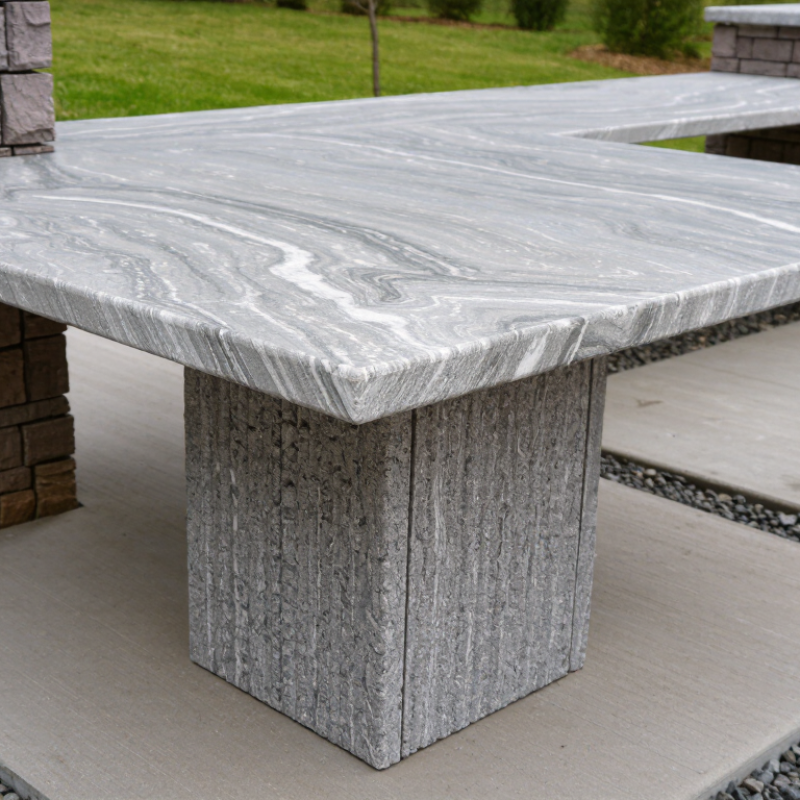
Landscaping offers more visible applications. Contractors use granite blocks beneath stone benches, outdoor kitchens, retaining-edge elements, and raised planters. They also support pavers and large natural-stone slabs where uneven settlement could create cracks. A level gravel bed and proper drainage remain essential. The block alone cannot correct weak soil.

Scale matters. The U.S. Geological Survey’s Mineral Commodity Summaries 2024 identifies crushed stone as one of America’s highest-volume mineral commodities, reflecting the constant demand for reliable construction aggregates. The Natural Stone Institute also emphasizes testing, tolerances, and installation quality for dimensional stone projects. These reports support a practical point: material selection must follow site conditions, not appearance alone.

A common mistake is using thin offcuts as structural supports. That can fail. Field inspections should look for rocking, hidden fractures, water pooling, and concentrated point loads. Slight movement today may become a costly repair after freeze-thaw cycles. Granite support blocks work best when their dimensions, placement, and drainage are designed together.

How Granite Support Blocks Distribute and Stabilize Loads

What Are Granite Support Blocks Used For?

How Granite Support Blocks Distribute and Stabilize Loads

Granite support blocks create a firm bearing surface beneath slabs, beams, columns, and heavy equipment. Their dense structure resists crushing under sustained pressure. When a load rests on a small contact point, stress can concentrate and cause cracking. A properly sized granite block spreads that force across a wider area. This reduces pressure on the supporting material below.

The load path matters. A countertop, for example, transfers weight into the block, then into the cabinet or wall beneath it. The block must sit fully flat, without rocking or unsupported edges. Small gaps can create uneven pressure. Moisture, dust, and surface irregularities may also weaken contact. Clean installation is essential. Thin leveling shims can help, but they should not replace accurate cutting or proper structural design.

Granite also improves stability by limiting movement and vibration. This is useful beneath machinery, stone panels, bridge components, and masonry elements. Its mass helps resist shifting, while its hardness maintains a consistent support point. Still, granite is not automatically suitable for every load. Block thickness, span, temperature, and impact must be evaluated by a qualified professional. Field conditions often differ from drawings. A block may look solid yet fail to bear evenly. Regular inspection can reveal rocking, cracks, staining, or new gaps before these issues become serious.

What Are Granite Support Blocks Used For? - How Granite Support Blocks Distribute and Stabilize Loads

Use or Application How the Block Supports the Load Typical Block Dimensions Primary Stability Benefit Important Installation Consideration
Raised granite slabs and countertops Creates intermediate bearing points that transfer the slab’s weight and service loads to the supporting frame or base. Commonly about 50–100 mm thick; plan dimensions often range from 100 × 100 mm to 300 × 300 mm. Reduces unsupported spans and limits rocking, deflection, and concentrated contact stresses. Support points should be level, fully seated, and positioned according to the slab’s structural design.
Granite steps and stair treads Distributes tread loads into the riser, stringer, wall, or prepared substrate rather than relying on a thin edge. Support strips or blocks are often 50–100 mm wide and approximately 50–100 mm deep, subject to the stair design. Improves resistance to movement, vibration, and edge cracking caused by repeated foot traffic. Use a continuous or regularly spaced bearing arrangement where required; avoid unsupported corners.
Outdoor pavers and landscape slabs Transfers pedestrian or light equipment loads into a compacted base or supporting pedestal system. Typical solid blocks are about 75–150 mm thick with plan dimensions of approximately 100–200 mm square. Helps maintain a level surface and reduces rocking when the underlying base is properly compacted. Drainage, frost movement, settlement, and soil bearing capacity must be addressed before installation.
Masonry veneer and façade stone Provides a bearing ledge or localized support that transfers the stone’s dead load to the wall structure. Support pieces are commonly sized to suit the veneer thickness, often 50–100 mm in bearing depth. Reduces tensile stress in anchors and limits sliding or differential movement of the stone. The supporting ledge, anchors, joints, and connections require project-specific structural verification.
Equipment and machinery bases Spreads static equipment weight over a larger contact area and provides a rigid bearing surface. Frequently 100–200 mm thick, with plan dimensions selected from the equipment footprint and anchor layout. Improves load distribution and reduces local settlement or distortion of the supporting floor. Dynamic loads, vibration, anchors, grout, and the capacity of the floor or foundation must be checked.
Temporary structural shoring Acts as a hard bearing pad beneath jacks, posts, frames, or temporary supports. Often selected at 100–200 mm thick with plan dimensions large enough to prevent punching or overturning. Increases bearing area and helps keep temporary supports plumb and stable. A qualified engineer should determine capacity, stacking limits, lateral restraint, and site safety requirements.
Monument, sculpture, and architectural stone bases Transfers vertical weight into the foundation while providing a broad, rigid interface. Commonly 100–300 mm thick; plan dimensions depend on the object footprint and overturning forces. Improves resistance to tipping, sliding, and uneven settlement. Wind, seismic effects, anchorage, drainage, and foundation design may control the required block size.
Material reference: Natural granite commonly has a density of approximately 2,630–2,750 kg/m³. Actual load capacity depends on block dimensions, stone quality, bearing area, load eccentricity, support conditions, anchorage, and applicable structural requirements. The dimensions shown are typical planning ranges, not universal design values.

Key Benefits of Using Granite Support Blocks

What Are Granite Support Blocks Used For?

Granite support blocks provide a firm base beneath stone slabs, machinery, monuments, and heavy structural components. On installation sites, workers use them to distribute weight across a wider area. This reduces concentrated pressure on concrete floors and fragile paving. Their precise, dense surface also helps maintain level alignment during fitting.

The material offers practical benefits. ASTM C615/C615M specifies a maximum water absorption of 0.40% for qualifying granite. Low absorption helps the blocks resist moisture-related damage in outdoor or damp environments. The same standard requires a minimum compressive strength of 131 MPa. That capacity supports demanding applications when the blocks are correctly sized and installed. They also resist abrasion, temperature changes, and repeated loading better than many softer materials.

Granite blocks can improve clearance beneath equipment, allowing inspection and cleaning below the supported item. They may also reduce minor vibration when placed on a properly prepared surface. The Natural Stone Institute’s Dimension Stone Design Manual stresses accurate bearing, stable substrates, and controlled tolerances. These details matter more than appearance alone. A block that looks solid can still fail if the ground settles unevenly. In practice, installers should check load calculations, contact area, drainage, and block condition before placement. Granite is strong, but it is not magic. Improper lifting or a small hidden crack can create a serious weakness. USGS dimension-stone production data also shows the material remains an established construction resource, though supply quality can vary by quarry and grade.

Selection, Installation, and Maintenance Considerations

Granite support blocks carry concentrated loads beneath countertops, stair treads, wall caps, and large stone panels. They reduce bending at weak points, especially around sink cutouts and wide overhangs. Selection should begin with load, span, and contact area. A dense granite block is not automatically suitable. Check compressive strength, flexural strength, absorption, and visible cracks. ASTM C170 evaluates compressive strength, while ASTM C880 evaluates flexural strength. These tests matter because granite performance varies by quarry and mineral structure.

The U.S. Geological Survey’s 2024 Mineral Commodity Summaries records roughly 1.7 million metric tons of U.S. dimension-stone production in 2023. That scale shows why material verification cannot be casual. Request test data for the actual stone, not a similar-looking sample. Fit matters. Blocks should sit on stable, level surfaces with continuous bearing. Use compatible bedding materials, and avoid hard point contact that may chip polished edges. Installers should measure the real slab after fabrication; drawings are often slightly optimistic.

Maintenance is simple but easy to neglect. Inspect joints, shims, and exposed edges twice yearly. Look for rocking, hairline cracks, rust staining, or moisture trapped beneath the block. Clean with a neutral stone cleaner, not acidic chemicals. A recurring site lesson is uncomfortable: adding more blocks does not correct poor alignment. If movement appears, unload the stone before adjustment. Documentation should include block dimensions, stone test results, installation date, and inspection photographs.

Granite Support Blocks: Material Selection and Load Considerations

Granite support blocks transfer concentrated loads, reduce point stress, and help prevent cracking or movement beneath stone slabs. The chart compares representative compressive-strength ranges for commonly considered support materials. Actual performance depends on stone quality, block dimensions, moisture, surface contact, installation alignment, and the design load. Inspect blocks regularly for cracking, settlement, rocking, or loss of full contact.

Article Source: