2025's Top 5 Rogowski Coil CTs: Best Choices for Accurate Current Measurement
As the demand for precise and reliable current measurement grows in various industries, the role of
Rogowski Coil Current Transformers (CTs) becomes increasingly vital.
Recent studies reveal that the global market for current transformers, including Rogowski coils, is projected to reach
$2.3 billion by 2025, with a CAGR of
6.5% from 2020 to 2025. This growth is largely driven by the
need for accurate power monitoring in renewable energy systems,
industrial automation, and energy management solutions.

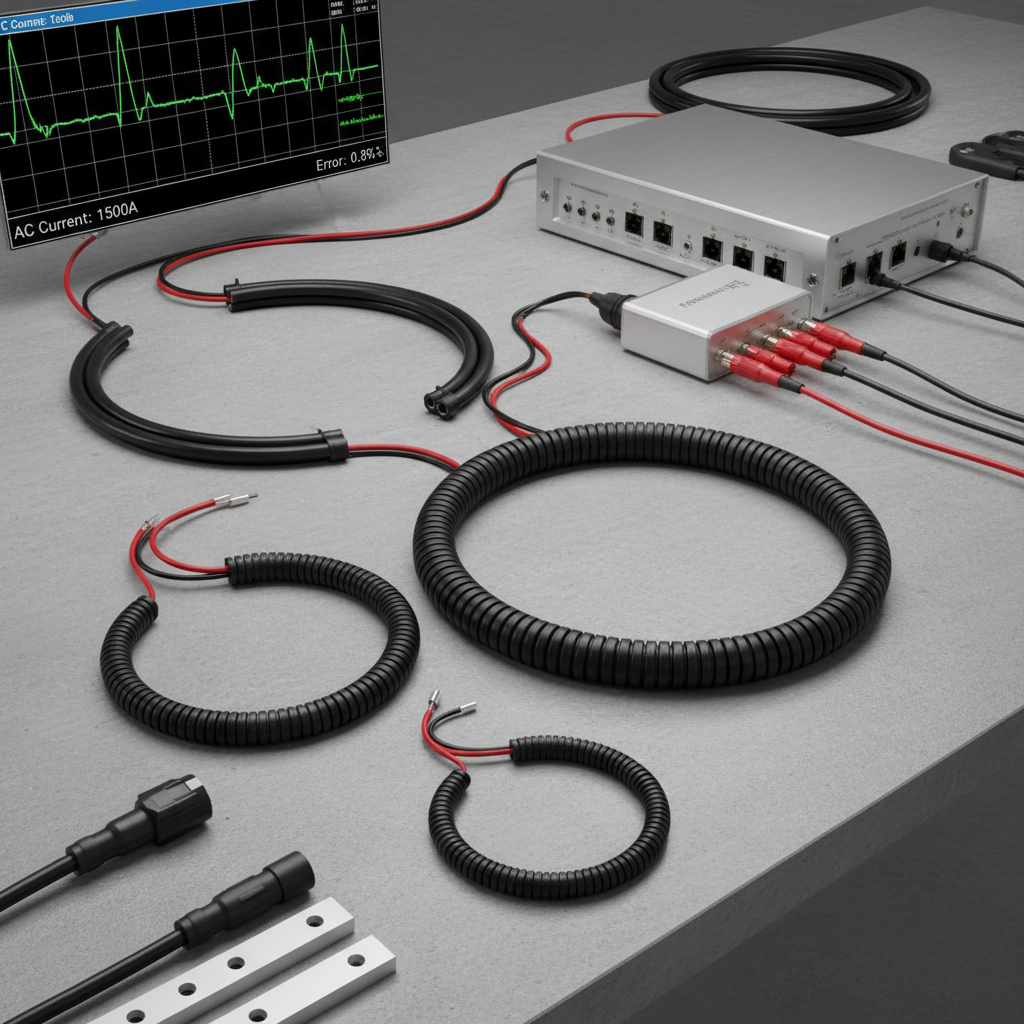
Rogowski coil CTs stand out for their flexibility, lightweight design, and capability to measure AC currents with high accuracy,
making them ideal for both high and low current applications. According to industry reports, these devices offer significant
advantages over traditional iron core CTs, such as a wider frequency response and less distortion, contributing to their
increasing adoption in smart grid technologies and electrical engineering.
As we approach 2025, it's essential to identify the top Rogowski coil CTs that can deliver exceptional performance and meet
the growing demands for accurate current measurement.
Understanding Rogowski Coils: Principles of Operation and Current Measurement Accuracy
Rogowski coils are a valuable tool in the field of current measurement, renowned for their accuracy and versatility. The principle of operation for a Rogowski coil is based on its design as a non-intrusive, air-core sensor that measures the magnetic field generated by alternating currents (AC). According to a report by the International Electrotechnical Commission (IEC), Rogowski coils can achieve measurement errors as low as 1% under ideal conditions, making them a preferred choice in high-demand applications, including industrial and renewable energy sectors.
One of the key advantages of Rogowski coils is their ability to handle a wide range of current levels without saturating, unlike conventional current transformers (CTs). ANSI/IEEE standards highlight that these coils maintain linearity even in high-current scenarios, with some models capable of measuring currents from microamperes up to several kiloamperes. Furthermore, a study published by the Institute of Electrical and Electronics Engineers (IEEE) demonstrates that the frequency response of Rogowski coils extends well into the megahertz range, facilitating accurate measurements in power quality and harmonic distortion assessments—crucial parameters in modern electrical systems.
Key Factors to Consider When Selecting Rogowski Coil CTs for Your Application
When selecting Rogowski Coil Current Transformers (CTs) for your application, several key factors must be considered to ensure accurate current measurement. First and foremost, the frequency range of the coil is critical. According to a report by the International Electrotechnical Commission, Rogowski coils are highly effective in measuring alternating currents with a frequency range from 1 Hz to 100 kHz, making them suitable for various power system applications including harmonics analysis and protection schemes. Users need to ensure that the selected coil can accurately measure the specific frequency of their application to avoid measurement errors.
Another important aspect is the positioning and size of the Rogowski coil. A properly sized coil that fits the conductor size enhances accuracy and reduces the likelihood of crosstalk or electromagnetic interference. A study published in the Journal of Electrical Engineering indicates that coils with a diameter not exceeding 20% of the conductor size can achieve optimal performance. Furthermore, the sensitivity characteristics of different models should also be examined; many high-quality Rogowski coils feature integrated signal conditioning, significantly improving the signal-to-noise ratio, as highlighted in the 2023 Global Electrical Measurement Report. This consideration is vital for critical applications where precise measurements are necessary for effective monitoring and control.
2025's Top 5 Rogowski Coil CTs: Best Choices for Accurate Current Measurement
| Model |
Current Range (A) |
Output Signal (mA) |
Frequency Range (Hz) |
Accuracy (% of Reading) |
Size (mm) |
Cable Length (m) |
| Model A |
10 - 1000 |
1 - 10 |
1 - 1000 |
±1.0 |
30 x 20 |
2 |
| Model B |
5 - 2000 |
0.5 - 5 |
10 - 500 |
±0.5 |
40 x 25 |
3 |
| Model C |
1 - 1500 |
1 - 20 |
5 - 300 |
±0.8 |
35 x 22 |
1.5 |
| Model D |
2 - 5000 |
0.8 - 8 |
1 - 400 |
±1.5 |
50 x 30 |
2.5 |
| Model E |
0.5 - 3000 |
1 - 12 |
20 - 600 |
±1.2 |
45 x 28 |
3 |
Comparative Analysis of 2025's Top 5 Rogowski Coil Current Transformers
In 2025, the choice of Rogowski Coil Current Transformers (CTs) has expanded significantly, catering to diverse applications in electrical measurement and monitoring. A comparative analysis of the top five CTs this year reveals crucial differences in design, accuracy, and application suitability. Each of these current transformers employs advanced technology to enhance precision while minimizing phase shift errors, a common issue in traditional CTs.
Among these leading options, factors such as frequency response, ease of installation, and environmental resilience play a vital role in their performance. For instance, some models excel in complex installations where space is limited, while others are designed for high-voltage environments, ensuring stable performance under varying conditions. This comprehensive overview not only highlights the strengths of each Rogowski Coil CT but also guides users in selecting the most appropriate model based on their specific measurement needs, ultimately contributing to improved efficiency and reliability in current monitoring systems.
2025's Top 5 Rogowski Coil CTs: Best Choices for Accurate Current Measurement
This chart presents a comparative analysis of the measurement accuracy of the top 5 Rogowski coil current transformers in 2025. The accuracy percentage indicates the reliability of each model for precise current measurements.
Real-World Applications: How Rogowski Coils Enhance Precision in Industrial Settings
Rogowski coils have emerged as essential tools in various industrial applications due to their ability to provide accurate and non-intrusive current measurements. Their flexible design allows them to be wrapped around conductors, making them ideal for measuring alternating current (AC) without disrupting the electrical circuit. This capability is particularly valuable in environments where space is limited or where traditional current transformers would be difficult to install. Industries such as power generation, manufacturing, and renewable energy significantly benefit from the precision offered by Rogowski coils, ensuring optimal performance and safety.
Moreover, the integration of Rogowski coils into monitoring systems enhances real-time data collection and analysis. By accurately measuring fluctuating currents, these coils enable engineers to detect anomalies in electrical systems, preventing potential failures and reducing downtime. Their lightweight nature and immunity to magnetic interference further empower maintenance teams to conduct inspections swiftly and efficiently. As industries strive for greater accuracy and reliability, the reliance on advanced measurement techniques like Rogowski coils continues to grow, illustrating their pivotal role in modern industrial settings.
Expert Insights: Future Trends in Current Measurement Technologies and Rogowski Coil Developments

In the evolving landscape of current measurement technologies, the Rogowski coil continues to play a crucial role. As we look towards 2025, advancements in design and integration are expected to significantly enhance the accuracy and reliability of current measurements across various industries. Experts predict that the incorporation of digital signal processing within Rogowski coils will lead to higher precision and responsiveness, making these devices indispensable for both industrial applications and long-term energy monitoring.
Moreover, emerging trends such as the Internet of Things (IoT) and smart grid technologies are poised to revolutionize how Rogowski coils are utilized. The need for real-time data and the capability to connect seamlessly with other digital devices will push for innovations in this domain. As manufacturers adapt to these requirements, we anticipate the development of compact, lightweight, and smart Rogowski coil designs that will cater to the demands of modern electrical systems, further solidifying their position as optimal solutions for accurate current measurement in the near future.
 X
X