China Best Integrated Solar LED Street Light Supplier?
Choosing China’s best Integrated Solar Led Street Light supplier takes more than comparing prices or bright product photos. The real test begins after sunset. Does the light maintain useful illumination through a cloudy night? Can the supplier explain how panel output, battery capacity, and LED wattage work together?
Hermann Scheer, a German renewable-energy advocate, is often credited with this observation: “The sun is the only safe nuclear reactor, situated as it is some 93 million miles away.” His remark captures solar power’s appeal, but dependable street lighting still depends on careful engineering. A supplier should provide clear product specifications, battery and panel details, photometric files, warranty terms, and test records. Ask how the fixture performs after several low-sunlight days. Request sample results, not only sales promises.
Look closely at the hardware. Check the housing, cable seals, mounting bracket, and battery access. These details matter on a wet roadside, where repairs can require a crew and a lift. Also confirm the stated runtime and dimming schedule under realistic conditions. One awkward truth: a high lumen figure alone cannot prove a road will be evenly lit. That needs proper optical data and site planning.
China has many manufacturers, but “best” depends on the project, climate, road layout, and after-sales support. Compare evidence, response times, and production consistency. A polished brochure helps little if replacement parts are slow. This guide examines those practical checks before identifying suppliers worth considering.
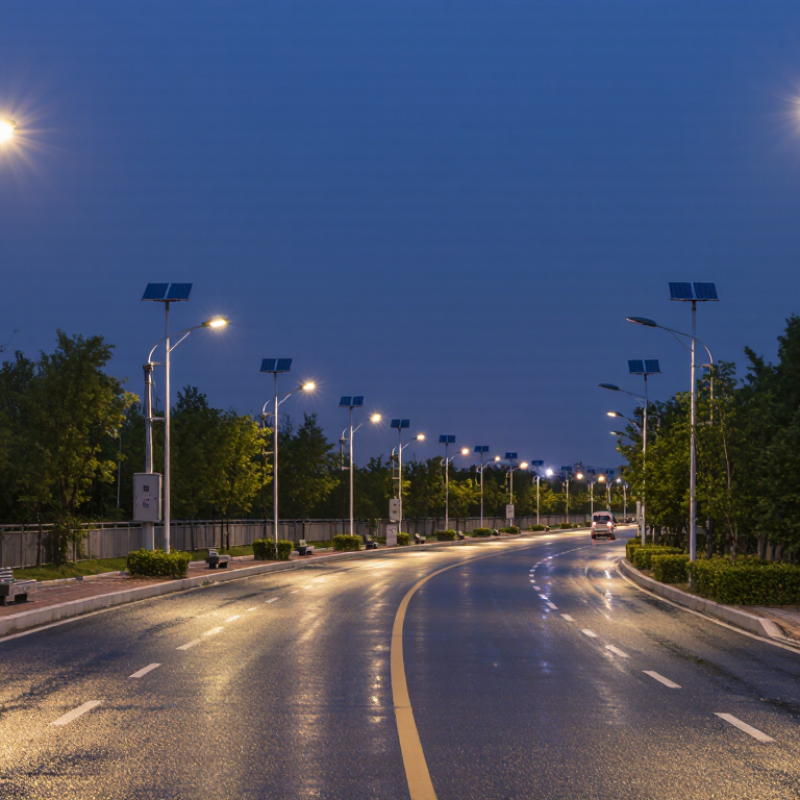
What Is an Integrated Solar LED Street Light?
An integrated solar LED street light combines a solar panel, LED module, rechargeable battery, and control electronics in one compact fixture. The panel collects sunlight during the day, while the battery stores energy for nighttime use. A controller manages charging and switches the light on when daylight fades. Some models also include motion sensors that brighten the light when people or vehicles pass.
No grid cable is usually needed. That can simplify installation along rural roads, parking areas, or pathways where trenching would be costly. But “integrated” does not mean maintenance-free. Shade from trees, dust on the panel, or several cloudy days can reduce available power. Battery capacity and local sunlight matter. A fixture that performs well in a sunny test site may provide shorter lighting hours through a darker season.
For a practical assessment, check the panel’s position, battery specifications, operating time, and light output—not just the advertised wattage. Look at the mounting height and the area that needs illumination, too. Small details count. I would also ask how the battery and LED module can be serviced. It is easy to overlook that part.
How Does an Integrated Solar Street Light Work?
China Best Integrated Solar LED Street Light Supplier?
How Does an Integrated Solar Street Light Work?
An integrated solar street light combines its photovoltaic panel, battery, controller, and LED module in one compact unit. In daylight, the panel converts sunlight into electrical energy. The controller manages charging and helps protect the battery from overcharging or excessive discharge. After dusk, a light sensor or programmed controller switches on the LEDs. At dawn, the system turns them off. It is straightforward.
The stored energy powers the lamp through the night, but runtime depends on battery capacity, LED output, and local weather. A shaded panel or several cloudy days can reduce available energy. For example, branches casting a shadow across the panel may limit charging even when the rest of the street is sunny. Proper panel orientation and an unobstructed installation matter.
Some models adjust brightness when nearby movement is low, conserving energy while maintaining useful light. This feature can help, but it does not replace careful system sizing. A neat, all-in-one housing can make installation simpler; it can also make component replacement less convenient. Check how the battery and controller can be accessed, and consider seasonal sunlight before choosing a system. No setup is perfect.
Which Specifications Matter When Comparing Chinese Suppliers?
When comparing Chinese integrated solar LED street light suppliers, look beyond the advertised lumen figure. Ask for measured light output, input power, beam distribution, and correlated color temperature. A 6,000-lumen claim means little without the test method and operating conditions. Request a lighting layout for your road width and pole spacing, not just a product brochure.
Check the solar panel’s rated wattage, battery capacity, and expected autonomy in cloudy weather. Confirm whether battery figures refer to nominal or usable capacity, and ask how the controller manages charging and dimming. Review the enclosure’s IP rating, corrosion protection, and operating temperature range for your site. Ask for reports from an independent laboratory and written warranty terms. A polished datasheet is useful, but it cannot predict every winter night or installation mistake.
Tips: Request a sample specification sheet and match every figure to supporting test records. Ask how many hours the light runs at full output, then at reduced output. Clarify replacement-part availability and service response times. Numbers need context. A small detail can change the whole comparison.
How Can You Evaluate a Solar Street Light Supplier in China?
Evaluating a solar street light supplier in China starts with evidence, not a polished catalogue. Ask whether the company designs and manufactures the system or mainly assembles components. Request a factory video, production records, and references for installations in climates similar to yours. Then check the technical documents: battery capacity and chemistry, panel output, LED performance, and enclosure ratings. Ask for photometric files, such as IES or LDT, so a lighting professional can assess road coverage and uniformity. Details matter. A certificate alone does not show how a complete fixture performs outdoors.
Check whether the supplier sizes the system for your site’s sunlight, shade, winter conditions, and required operating hours. Ask for the assumptions behind its autonomy calculation and dimming schedule. A sample should be tested for practical details, including charging behavior, controls, and ease of opening the battery compartment. I would not rely on warranty length alone; clarify exclusions, replacement parts, response times, and who handles technical support. It is easy to miss those points when comparing quotations. A small pilot installation can reveal uneven lighting or installation issues before a larger order is placed.
How to Evaluate a Solar Street Light Supplier in China
Suggested buyer-defined evaluation weights for comparing integrated solar LED street light suppliers.
These weights are a practical evaluation framework, not market statistics. Review test reports, component specifications, compliance documents, quality controls, warranty terms, and relevant project references before making a decision.
 X