• Products
  • Solutions
  • Support
  • Contact
  • Order OnlineOrder Online

China Top SMC Slice Material Press Manufacturer?

Choosing the China Top Smc Slice Material Press Manufacturer requires more than comparing machine prices. The right supplier must understand sheet molding compound, compression behavior, and repeatable production control. A capable manufacturer should provide stable platen parallelism, accurate temperature zones, reliable hydraulic pressure, and responsive after-sales support.

Chen Wei, a senior SMC process engineer with more than fifteen years of factory experience, says, “A press is only reliable when heat, pressure, and cycle time remain controlled together.” This principle matters on the production floor. A typical SMC Slice Material Press may handle heavy charge stacks, heated molds, and repeated compression cycles. Small temperature differences can create incomplete filling, surface marks, or inconsistent fiber distribution. The details are visible.

Look for evidence, not attractive brochures. Ask for recorded trial data, platen flatness results, pressure-holding tests, and references from comparable composite plants. Inspect the hydraulic station, electrical cabinet, safety interlocks, and mold-change arrangement. These practical points reveal manufacturing discipline. They also expose weak assumptions.

The best Chinese suppliers may offer customized press dimensions, automation options, remote diagnostics, and operator training. However, “top” depends on your product, annual output, material formulation, and local service expectations. One manufacturer may excel at automotive panels, while another suits electrical housings or sanitary components. There is no universal winner.

A careful evaluation should compare total ownership cost, not only the purchase quotation. Energy use, spare parts, maintenance access, and commissioning time can change the final result. Some specifications remain unclear until testing begins. That is worth questioning. Reliable selection combines engineering proof, customer feedback, and a realistic factory visit.

China Top SMC Slice Material Press Manufacturer?

What Is an SMC Slice Material Press?

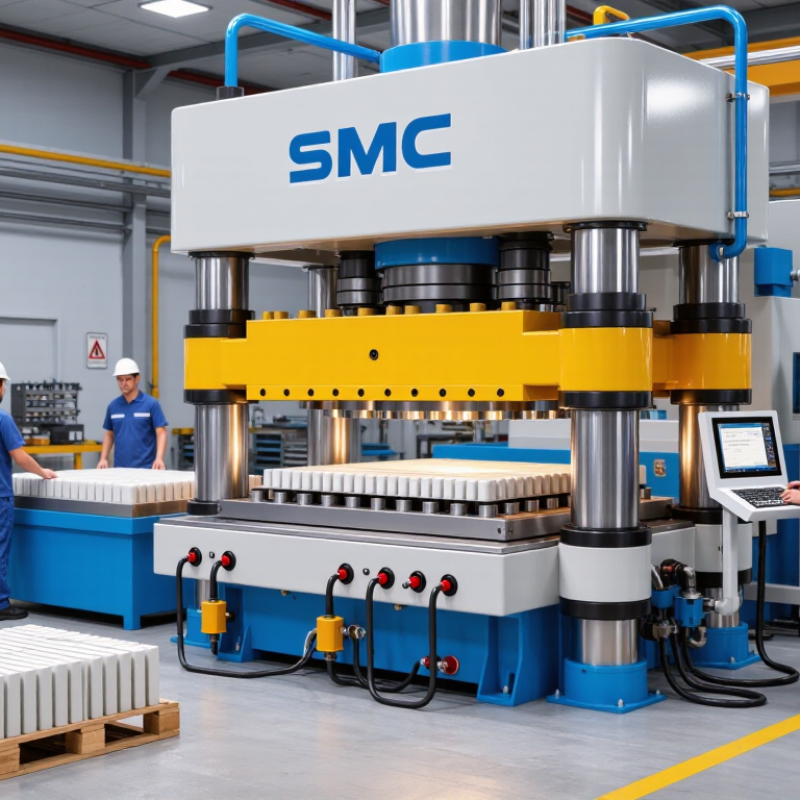
An SMC slice material press is industrial equipment for shaping Sheet Molding Compound into reinforced composite parts. SMC contains resin, chopped glass fibers, fillers, pigments, and curing agents. The press places this prepared material inside a heated mold. Controlled pressure then spreads and compresses it into the required geometry.

The process starts with accurate material weighing and clean mold preparation. Operators usually place measured SMC slices across the cavity, rather than dropping them randomly. Heated platens soften the compound and activate curing. Pressure must remain stable while the material flows into ribs, corners, and mounting points. Excessive pressure can cause flash or fiber movement. Insufficient pressure may leave voids.

Small details matter. A practical press should offer rigid frames, synchronized cylinders, reliable temperature control, and clear pressure feedback. Mold alignment also affects surface quality. From production experience, trial settings often need adjustment for part thickness, fiber content, and mold design. There is no universal recipe. Sometimes the first cycle looks acceptable but hides uneven curing. That mistake deserves attention. Buyers comparing Chinese manufacturers should request load-test records, sample parts, hydraulic diagrams, and maintenance guidance. A factory’s machining accuracy matters, but its process support matters too.

Key Features of China’s Leading SMC Press Manufacturers

China Top SMC Slice Material Press Manufacturer?

Key Features of China’s Leading SMC Press Manufacturers

China’s leading SMC press manufacturers design equipment for stable forming, not only impressive tonnage. Their hydraulic systems control pressure during compression molding. A 1,000-ton press can produce panels, electrical housings, and automotive components. The frame must resist deflection during repeated cycles. Otherwise, part thickness may vary across the mold.

Temperature control is equally important. Independent platen zones help maintain even heat across the mold surface. Practical manufacturers provide sensor layouts, heating response data, and cycle-time records. They also check mold alignment with digital measurement tools. Small deviations matter. A few tenths of a millimeter can create flash or incomplete filling.

Reliable suppliers usually offer material traceability, factory acceptance testing, and maintenance instructions. Engineers may test sample parts with the customer’s SMC formulation before shipment. This can reveal curing problems that a catalog cannot show. Safety guards, two-hand controls, overload protection, and emergency stops require verification during commissioning. Certifications help, but they cannot replace documented testing. No factory gets every trial perfect. A thoughtful manufacturer records defects, adjusts pressure ramps, and explains remaining risks honestly. Buyers should request load charts, platen flatness reports, spare-part lists, and service response times before ordering.

SMC Slice Material Press Manufacturing Process

China Top SMC Slice Material Press Manufacturer?

SMC slice material press manufacturing begins with a clear production requirement. Engineers confirm sheet size, charge weight, mold dimensions, and required pressing force. A strong welded frame supports the mold accurately. Hydraulic cylinders then create stable pressure during forming. Heating plates must distribute heat evenly across the mold surface. Even a small temperature difference can cause weak corners or uneven surfaces.

During assembly, technicians install the hydraulic circuit, heating elements, sensors, and control cabinet. Each component is checked before trial operation. The press is tested under no-load and full-load conditions. Engineers monitor pressure stability, closing speed, platen alignment, and emergency protection. The process is not perfectly linear. Sometimes, a sensor reading looks correct but reveals a calibration problem during production. That experience makes repeated testing necessary.

Tips: Keep the SMC charge clean and accurately weighed. Place it near the mold center, then control closing speed carefully. Record temperature, pressure, curing time, and part defects for every trial. Do not ignore minor flash or surface marks. They may indicate poor alignment, uneven heating, or insufficient mold maintenance. Regular inspection improves reliability, although operators may still need to adjust settings for different materials.

How to Evaluate Press Quality, Capacity, and Technology

Choosing a China-based SMC slice material press manufacturer requires more than comparing advertised tonnage.

MarketsandMarkets valued the global composites market at about USD 106 billion in 2023 and forecasts continued growth through 2028. That pressure increases the need for stable, repeatable molding equipment.

Check press quality through measurable evidence.

Ask for platen parallelism, pressure repeatability, temperature uniformity, and recorded cycle data. A reliable press should maintain consistent force across the mold surface, not only display a high maximum tonnage.

During factory visits, inspect hydraulic leakage, guide-column wear, heating-zone balance, and emergency protection. Small defects often become expensive scrap.

Capacity must match the SMC part, mold size, and planned production rhythm.

Compare clamping force, daylight opening, platen dimensions, closing speed, and usable stroke. A larger frame is not automatically better. MarketsandMarkets also reports that automotive applications remain a major composites demand area, where cycle consistency strongly affects output.

Technology matters in daily operation: servo-hydraulic control, recipe storage, pressure curves, automatic material feeding, and remote diagnostics can reduce operator variation.

Energy monitoring is useful too. The U.S. Department of Energy notes that industrial motor systems can represent a significant share of factory electricity use, although savings depend on the whole process.

One overlooked test is mold-change time. It can expose weak planning quickly. Ask for customer acceptance records, not polished demonstrations. Supplier claims still need independent verification.

Main Applications of SMC Slice Material Presses

Main Applications of SMC Slice Material Presses

SMC slice material presses shape pre-measured sheet molding compound under controlled heat and pressure. They are widely used for automotive parts, including battery covers, body panels, and underbody shields. The process creates rigid components with stable dimensions and good surface quality. It also supports complex ribs, mounting points, and integrated contours. However, mold filling can change when material temperature or slice placement is inconsistent. Small setup errors matter.

Electrical manufacturers use these presses for meter boxes, switchgear covers, and insulated housings. SMC offers electrical insulation, corrosion resistance, and reliable performance in demanding environments. Construction projects may use pressed SMC parts for access covers, façade components, and utility cabinets. Other applications include appliance panels, water-treatment equipment, and selected transportation interiors. Each application requires careful control of pressure, curing time, and mold temperature.

Tips: Check slice weight, fiber direction, and material freshness before pressing. Keep the mold surface clean. Record defects, even minor ones. A short filling test can reveal uneven flow before full production. Operators should also inspect flash, voids, and warpage after demolding. The best setting is not always the fastest one.

China Top SMC Slice Material Press Manufacturer? - Main Applications of SMC Slice Material Presses
Typical application and process reference for hydraulic compression presses used to mold Sheet Molding Compound (SMC) components.
Application Area Typical SMC Products Key Performance Requirements Typical Press Capacity Typical Mold Temperature Typical Cycle Time Main Process Benefits
Electrical Enclosures Meter boxes, distribution-board covers, junction boxes and control cabinets Electrical insulation, flame-retardant performance, dimensional stability and weather resistance 500–2,500 metric tons 140–170°C 2–8 minutes Produces complex insulating parts with integrated ribs, bosses and mounting features
Automotive Exterior Parts Front-end panels, battery trays, underbody shields and spare-wheel wells Low weight, impact resistance, corrosion resistance and stable surface quality 800–4,000 metric tons 140–165°C 2–6 minutes Supports large-area molding and replaces selected metal components with corrosion-resistant composites
Automotive Interior Parts Seat shells, door substrates, package shelves and structural interior panels Low odor, dimensional accuracy, stiffness and compatibility with interior finishing processes 500–2,500 metric tons 135–165°C 2–7 minutes Allows one-step forming of reinforced panels with repeatable thickness and geometry
Construction Components Access covers, drainage covers, façade panels and utility cabinets Load-bearing capability, moisture resistance, UV stability and low maintenance 800–3,500 metric tons 140–170°C 3–10 minutes Delivers corrosion-resistant components suitable for outdoor and infrastructure applications
Water and Sanitation Equipment Pump covers, treatment-equipment housings, inspection covers and septic-system components Chemical resistance, low water absorption, stiffness and durable surface finish 500–2,500 metric tons 140–170°C 3–9 minutes Forms sealed housings and covers with fewer joints than assembled sheet-metal structures
Railway and Transportation Interior panels, equipment covers, seat components and cable-management parts Fire and smoke performance, stiffness, dimensional control and reduced structural weight 1,000–5,000 metric tons 145–170°C 3–10 minutes Suitable for reinforced composite panels requiring repeatable production and integrated details
Renewable-Energy Equipment Electrical housings, inverter covers, battery enclosures and support components Electrical insulation, heat resistance, flame retardancy and environmental durability 800–3,500 metric tons 140–170°C 3–8 minutes Combines high stiffness with insulation and corrosion resistance in outdoor equipment
Agricultural Machinery Fan housings, protective guards, equipment covers and operator-compartment panels Impact resistance, chemical resistance, weatherability and low maintenance 500–2,500 metric tons 140–165°C 2–8 minutes Produces robust shaped parts that resist moisture, fertilizers and common agricultural chemicals
Industrial Equipment Machine guards, motor housings, control-panel covers and ventilation components Stiffness, flame resistance, dimensional accuracy and resistance to oils or chemicals 500–3,000 metric tons 140–170°C 2–8 minutes Enables repeatable compression molding of reinforced, near-net-shape industrial parts
Telecommunications Equipment Outdoor cabinets, antenna housings, cable boxes and equipment covers Electrical insulation, radio-transparency, weather resistance and dimensional stability 500–2,000 metric tons 140–165°C 2–7 minutes Provides durable non-metallic housings that protect equipment from moisture and corrosion
Note: The stated capacity, mold-temperature and cycle-time ranges are typical industry references. Actual settings depend on part size, SMC formulation, charge weight, mold design, wall thickness, required surface quality and production-volume targets.